Tax and cross-border
The Tax screen estimates what fund domicile and your tax residence cost you: the dividend tax lost at source and at home, how much of it a different fund structure would avoid, and your exposure to US estate tax.
What the figures depend on
Everything on Insights → Tax depends on your tax residence and the settings beside it (citizenship, whether a W-8BEN is on file, your home rates). Set them under the gear on the Tax screen or in Residency settings; until a residence is set, the screen asks for one. The figures are estimates on stated assumptions, not tax advice.
How a fund's domicile is found
A fund's domicile comes from its ISIN country prefix (IE, LU, US and so on). For depositary receipts the issuer's home listing is used. A ticker found in the catalogue of US funds with UCITS alternatives is treated as US. Anything else is shown as not classified rather than guessed.
Dividend tax drag
The first card shows how much of a year's dividends is lost to tax, in two steps: withheld at source by the fund's country, then taxed at home under your residence. The remainder is what you keep. It also states how much of the withholding is structural: the part an Irish-domiciled wrapper would avoid, because it caps source withholding on US dividends at 15% inside the fund.
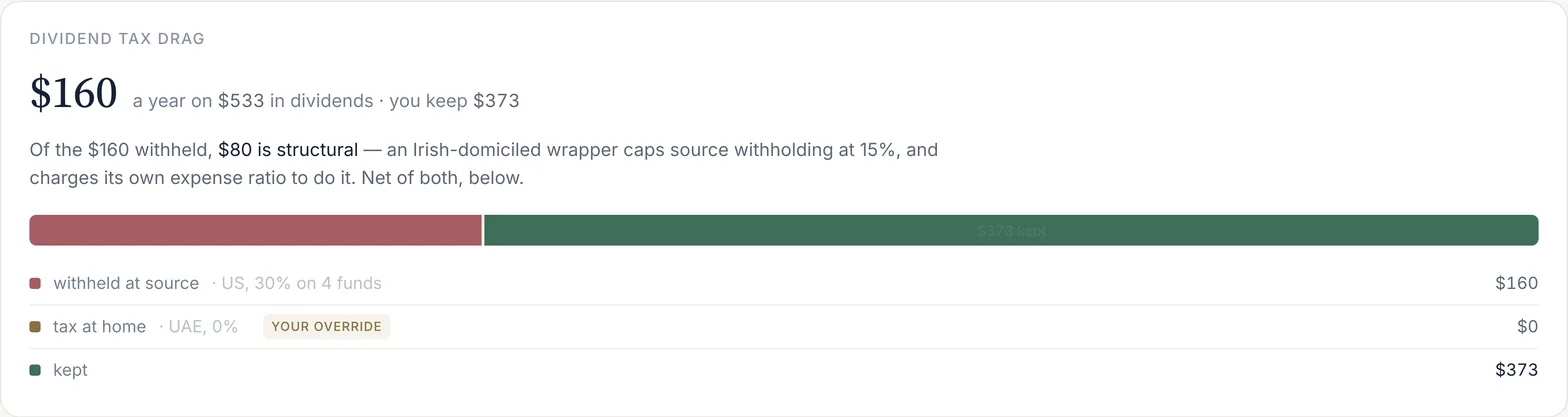
For a US fund the rate is your treaty rate, raised to the 30% statutory rate if no W-8BEN is on file. For a non-US fund it is the treaty rate between the fund's domicile and the US, applied inside the fund. Securities exempt from withholding are taken at 0%. Rates come from the IRS treaty table; residences without a treaty are taken at 30%. The full method is in withholding methodology, and every residence has its own withholding page.
Structural leak
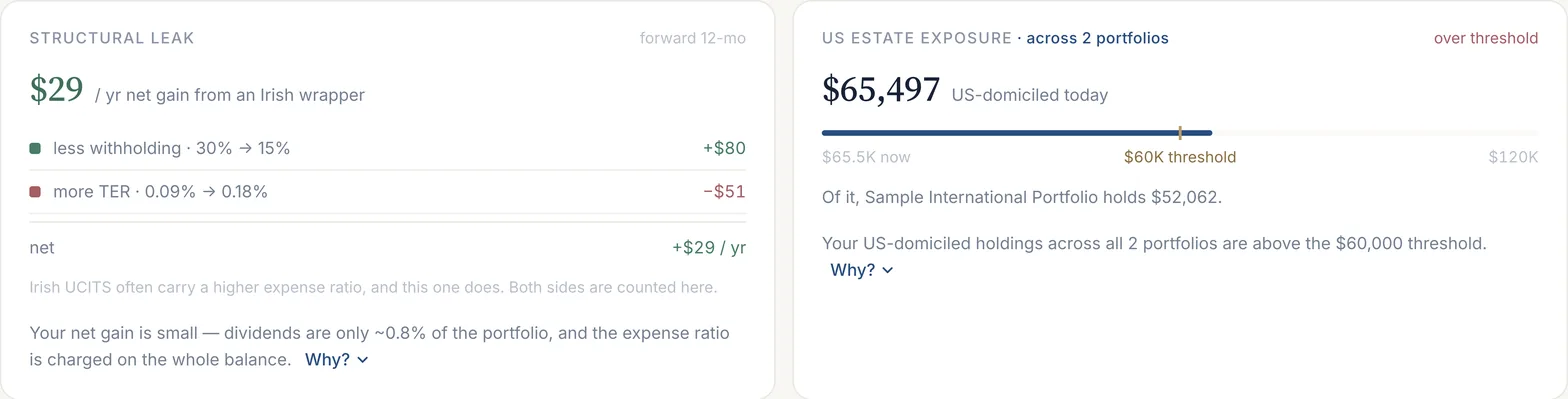
The structural leak is the net gain a year from holding Irish-domiciled UCITS equivalents instead of your US-domiciled funds: less withholding, minus the higher expense ratio a UCITS fund often charges. It can come out negative, and the card says so when switching would not help or the portfolio is already efficient.
US estate exposure
Non-residents of the US face US estate tax of up to 40% on US-situs assets above $60,000, unless a treaty provides otherwise. Irish-domiciled UCITS funds sit outside its scope. The card shows your US-domiciled holdings against the threshold and, if you are below it, roughly when you would cross it. Because the threshold applies to you, not to an account, the figure always adds up all your portfolios.
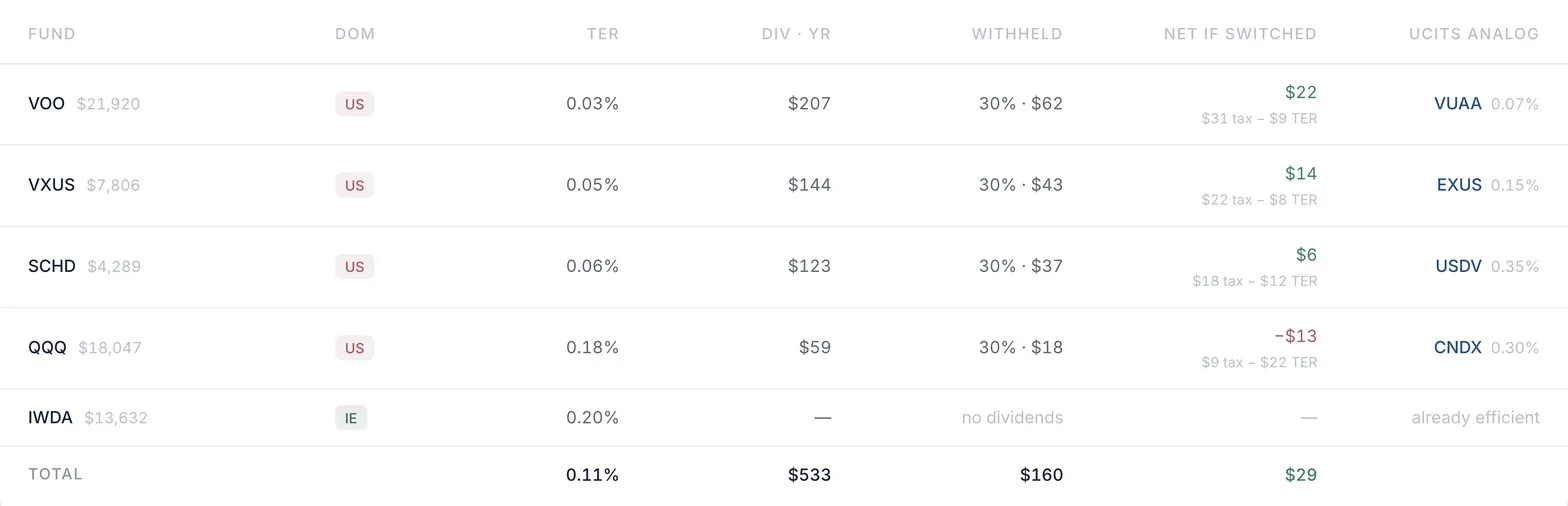
By fund Pro
The by-fund table lists each holding with its domicile, expense ratio, dividends a year, the amount withheld, the net gain a year if switched, and the UCITS analogue it is compared with. On Free, the table is shown as a preview.
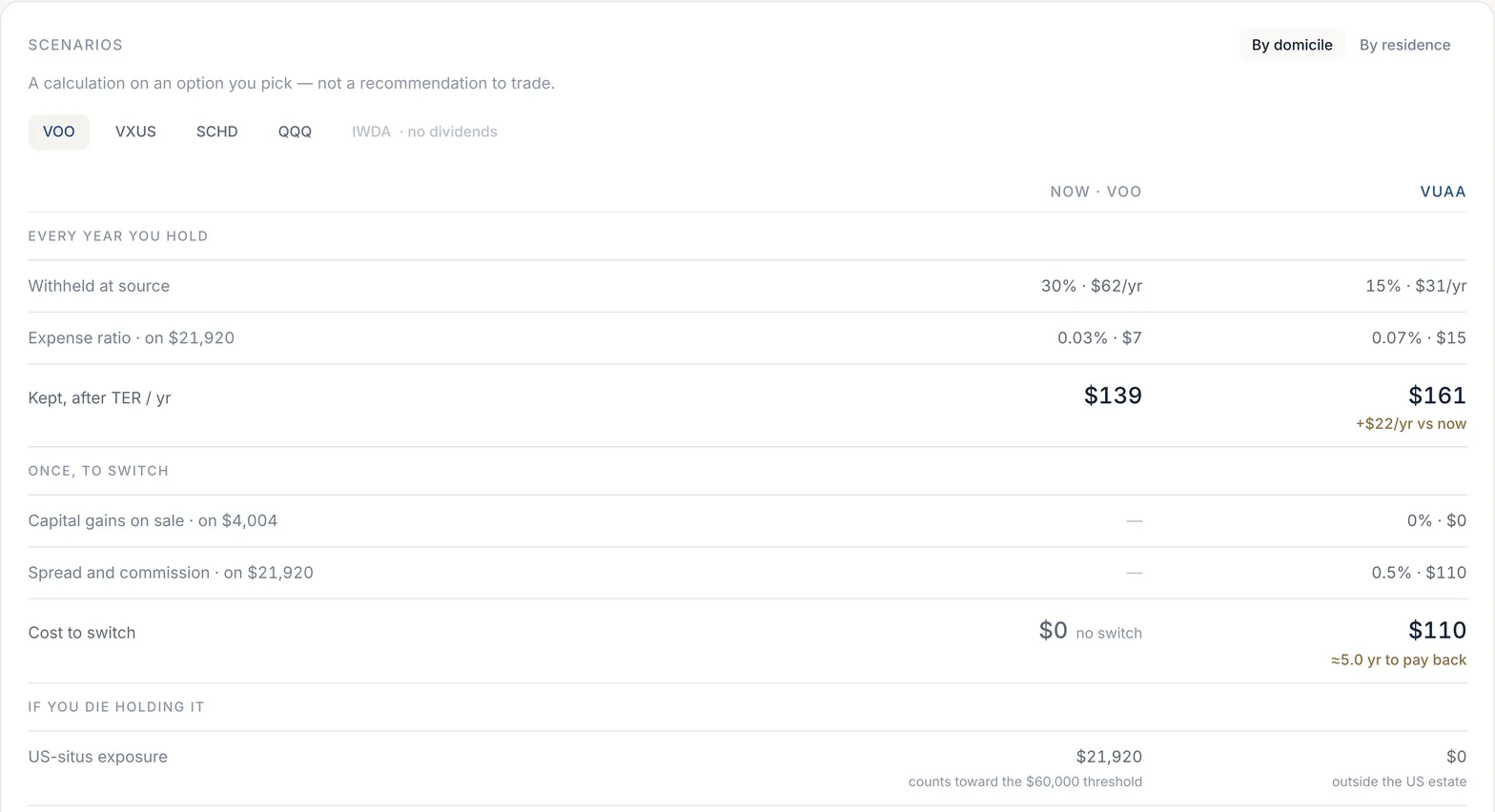
Scenarios Pro
Scenarios calculate an option you pick, without recommending it. By domicile takes one of your funds and compares it with its UCITS analogue: what you keep each year after withholding and expense ratio, the one-off cost to switch (capital gains tax on the sale and an assumed 0.5% for spread and commission) and how long it takes to pay back, and the US-situs exposure if you die holding it. By residence compares your current residence with others: withholding and local dividend tax while you hold, capital gains tax and net proceeds if you sold today, and whether a US estate-tax treaty applies.
The reasoning behind domicile and withholding is laid out in US ETFs vs Irish UCITS and the US ETF to UCITS switch study.
Last updated . Describes the app at app.borderfolio.app as built; screenshots are from the sample portfolio. Figures in the app are informational estimates, not tax, legal or investment advice.